



Presby-LASIK & Monovision techniques
[sliders][slider title=”Presbyopia and laser”] Presbyopia and laser: After the age of 40 the ability of automatic adaptation of the eye at all distances, close and distant, gradually decreases. This, according to the existing theories, whether due to gradual loss of elasticity of the eye lens, which loses the ability to change a curvature and focus […]
[sliders][slider title=”Presbyopia and laser”]
Presbyopia and laser:
After the age of 40 the ability of automatic adaptation of the eye at all distances, close and distant, gradually decreases. This, according to the existing theories, whether due to gradual loss of elasticity of the eye lens, which loses the ability to change a curvature and focus at near distances, or the progressive atrophy due to aging of the muscle, which the lens rests upon (ciliary muscle).

The adaptation of our vision at close distances, in contrast to myopia, hyperopia and astigmatism, as the static conditions and due to the shape and size of each eye is a dynamic and constantly changing eye function. That is why the treatment of presbyopia with excimer laser is not as easy as that of myopia, hyperopia and astigmatism.
[/slider][slider title=”Presy-LASIK technique”]
What exactly is the Presby-LASIK technique?
The refractive Presby-LASIK technique is likened like a multifocal laser (multifocal laser) and it is used in refractive patients besides addressing common refractive errors (myopia, hyperopia and astigmatism), wish to address presbyopia as well, due to aging. The method is based on the operating principles of multifocal intraocular lenses (multifocal IOLs for near, intermediate and distant vision).

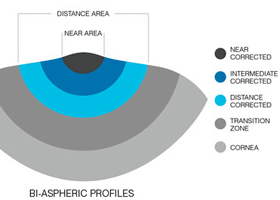
In the cases of hyperopic presbyopia (in particular with Z-LASIK and femtosecond laser), it has excellent effects. The Presby-LASIK gives satisfactory near vision (perhaps with some restrictions). Middle-aged or elderly are possible to be served satisfactorily. The technique is constantly growing and it is based on specific nomograms and algorithms held in the settings and programming of excimer laser (ablation profile settings) before each treatment.
{/slider}{slider=Monovision technique}
What exactly is the Monovision technique?
The Monovision technique in laser refractive surgery, is applied by the refractive surgeon when a candidate, other than the correction of distance vision, needs assistance in walking just because starts presbyopia (progressive loss of elasticity of the eye lens, which loses the ability changing curvature and focus on short distances). With the Monovision technique, the objective is for a person to use one eye to see far and one for seeing near, i.e. one eye is corrected for near vision (near vision), and the other for distant (distant vision).
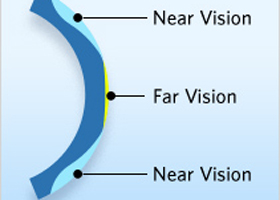

The Monovision technique is not recommended for all refractive patients who have to cope with presbyopia, since many are those who find it difficult to get used to a different ability to adapt to each eye. It is appropriate, therefore, before a candidate undergone Monovision with excimer laser, to try contact lenses the refractive state in order to make sure that postoperatively can be customized. The Monovision LASIK is a smart solution exemption from glasses and contact lenses for people over 45.
[/slider][/sliders]
Απόφραξη Φλέβας Αμφιβληστροειδή: «Οφθαλμικό εγκεφαλικό»
Τι ακριβώς είναι η απόφραξη φλέβας αμφιβληστροειδή; Φλεβική απόφραξη συμβαίνει όταν στην πραγματικότητα αποκλειστεί μια φλέβα στο οπίσθιο τμήμα του οφθαλμού, δηλαδή στον φωτοευαίσθητο χιτώνα που ονομάζεται αμφιβληστροειδής, ο οποίος είναι υπεύθυνος για τη μετατροπή των φωτεινών ερεθισμάτων σε ηλεκτρικά σήματα (νευρικά μηνύματα), πριν διαβιβαστούν μέσω του οπτικού νεύρου στον ανθρώπινο εγκέφαλο. Μια απόφραξη φλέβας […]
Ραγοειδίτιδες: Αντιμετωπίστε τις ενδοφθάλμιες φλεγμονές
Τι είναι ο ραγοειδής χιτώνας; Αν σκεφτούμε το μάτι σαν μια σφαιρική κατασκευή που εσωτερικά περιέχει υγρό και εξωτερικά καλύπτεται από 3 τοιχώματα, τα τοιχώματα αυτά από έξω προς τα μέσα είναι: ο σκληρός χιτώνας ο ραγοειδής χιτώνας ο αμφιβληστροειδής χιτώνας Ο ραγοειδής χιτώνας αποτελείται από: την ίριδα το ακτινωτό σώμα τον χοριοειδή Περιλαμβάνει πολυάριθμα […]
Ενδοστρωματικοί Κερατοειδικοί Δακτύλιοι Kerarings | Διόρθωση των διαθλαστικών ανωμαλιών που σχετίζονται με τον Κερατόκωνο
Οι Ενδοστρωματικοί Κερατοειδικοί Δακτύλιοι Kerarings είναι οφθαλμολογικά εμφυτεύματα που χρησιμοποιούνται για τη διόρθωση των διαθλαστικών ανωμαλιών που σχετίζονται με τον κερατόκωνο και άλλες εκτατικές διαταραχές του κερατοειδούς. Πρόκειται στην ουσία για δακτυλίους, οι οποίοι εμφυτεύονται στο εσωτερικό του οφθαλμού, και πιο συγκεκριμένα στο στρώμα του κερατοειδή, με σκοπό την αναδιαμόρφωση και ομαλοποίησή του σχήματός του. […]